Drone mobile surveillance
Surveillance investigations have changed dramatically over the past decade. Traditional stakeouts still work, but sometimes you need a different perspective. That’s where drone technology has become a powerful investigative tool.
At Paramount Investigative Services Inc., we use drones when conventional a surveillance investigation might not work. Aerial imagery allows us to capture angles and movements that would be impossible from the ground. Whether documenting accident scenes, observing large properties, or reconstructing events, drones provide investigators with an entirely different vantage point.

We primarily use DJI drones because they’re reliable, affordable, and produce excellent video and still images. I’ll be honest. I’m not the world’s best drone pilot, so I usually buy them used. If one gets clipped by a tree or takes a hard landing, it’s not the end of the world. The upside is that even these affordable drones capture incredibly detailed footage that can become critical evidence in an investigation.
Using Drone Surveillance in Investigations
We use drones for aerial pictures and videos of accident scenes
Drone technology allows investigators to gather information in situations where traditional surveillance would fail.
For example, we often use drones to photograph accident scenes from above. Aerial images can clearly show traffic patterns, lane configurations, visibility obstructions, and intersection layouts. These images frequently help attorneys reconstruct what actually happened in a collision.
Drones are also useful in residential investigations. In some cases, a subject may live inside a gated community where vehicle surveillance is nearly impossible. A drone allows us to safely determine whether a subject’s vehicle is present without drawing attention.
In one case, we used a drone in a workers’ compensation investigation. The injured worker claimed to be physically disabled was regularly visiting a local golf driving range and swinging clubs without difficulty. From the ground, that activity would have been difficult to document without being detected. From above, the activity was clear.
Drone Evidence in a Bicycle Accident Investigation
One of the more interesting cases involved a cyclist who was struck by a motor vehicle at an intersection. The cyclists involved in the ride all gave statements, but their accounts were inconsistent and conflicting.
Based on the design of the intersection, it appeared that the cyclists had simply blown through a stop sign as a group.
We started by identifying the cycling group and learning when their regular rides took place. The following week, we located the group as they prepared for another evening ride. After documenting the riders, we drove to the same intersection where the accident had occurred and launched a drone above the intersection.
Not long after, the cyclists approached.
From the aerial view, it was clear what happened. The group rode through the intersection at speed and ignored the stop sign entirely. They didn’t slow down. They didn’t stop. They simply blew through the intersection.
We repeated the surveillance the following week and documented the exact same behavior.
The drone footage provided the motorist’s attorney with powerful evidence showing the riding habits of the group and how they routinely disregarded traffic controls. That evidence became critical to the defense of the case.
Drone Investigation That Proved a Client’s Innocence
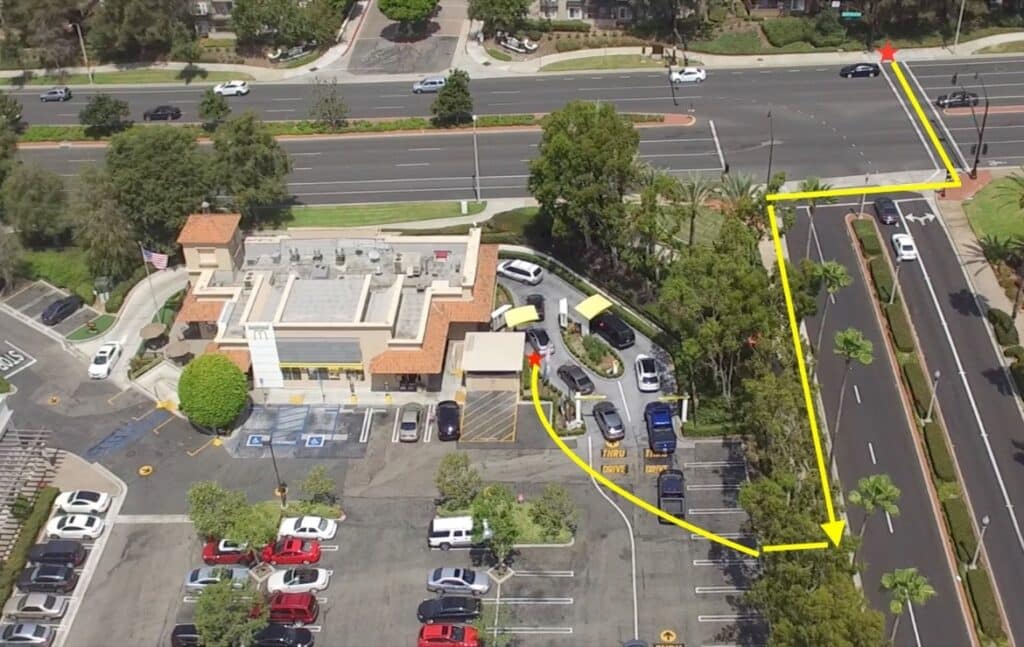
In another case, a client was accused of aggressively following a pedestrian after a verbal confrontation at an intersection near a McDonald’s.
According to the pedestrian, my client had pursued him in a vehicle to continue the confrontation. The allegation suggested that my client had deliberately followed the pedestrian to intimidate him.
The facts told a different story.
My client left the intersection and drove directly to a nearby McDonald’s drive-thru. While he was waiting in line, the same pedestrian suddenly appeared again and began confronting him a second time.
To analyze what actually happened, I flew a drone roughly 400 feet above the area and captured high-resolution aerial imagery of the entire intersection and surrounding businesses.
Using that footage, I mapped the pedestrian’s walking route.
The results were clear. The pedestrian had walked approximately 300 feet from the original intersection to the McDonald’s parking lot in order to reach my client’s vehicle in the drive-thru line. My client hadn’t followed him at all. The pedestrian had gone out of his way to track my client down.
The aerial images allowed us to clearly demonstrate the pedestrian’s path and distance traveled. When presented with the evidence, it became obvious who had actually initiated the second confrontation.
The drone footage helped establish that my client was not the aggressor.
The Future of Drone Surveillance in Investigations
Drone technology has become an increasingly valuable tool for investigators, particularly when documenting accident scenes, large areas, or locations that are difficult to observe from the ground.
Like any investigative technique, drones must be used responsibly and within the law. When used properly, however, they provide investigators with powerful visual evidence that can clarify events, support legal arguments, and sometimes completely change the direction of a case.
For investigators willing to adopt the technology, the aerial perspective can reveal details that would otherwise remain hidden.
Though we use drones for unmanned surveillance, please read why unmanned surveillance sucks for your insurance fraud investigations.